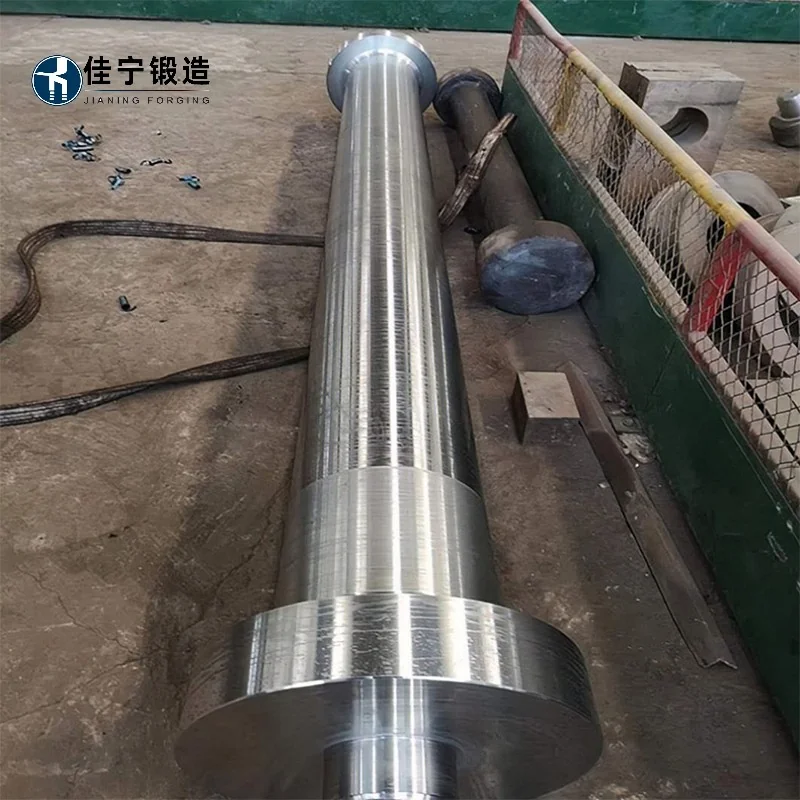
Ships operate long-term in complex sea conditions, with stern shafts subjected to the dual challenges of alternating loads and seawater corrosion, making fatigue cracks and fractures highly susceptible, leading to soaring maintenance costs during downtime. Jianing Forging's stern shaft forgings use relatively high-strength alloy steel and fine forging processes, enhancing fatigue resistance and corrosion resistance from the material source, providing stable and reliable power transmission suppor
Ships operate long-term in complex sea conditions, with stern shafts subjected to the dual challenges of alternating loads and seawater corrosion, making fatigue cracks and fractures highly susceptible, leading to soaring maintenance costs during downtime. Jianing Forging's stern shaft forgings use relatively high-strength alloy steel and fine forging processes, enhancing fatigue resistance and corrosion resistance from the material source, providing stable and reliable power transmission support for ships.
The stern shaft forgings produced by Caring Forging are key components of marine ship shaft systems, suitable for various commercial ships, engineering vessels, and special vessels. Products are made from high-quality alloy steels (such as 35CrMo, 42CrMo, 18CrNiMo7-6, etc.), formed through free forging or die forging, and treated with processes such as quenching and flaw detection to meet classification society standards. Compared to cast or ordinary rolled shafts, forgings have a dense internal structure, no pores, and more uniform mechanical properties, thereby extending service life.
High-quality alloy steel materials: Materials selected according to different working conditions, with stable chemical composition, high purity, and excellent overall mechanical properties.
Temperature-controlled forging process: Uses multiple burns and large pressure forgings to refine grains, eliminate casting defects, and achieve rational flow distribution.
Full-process flaw detection: 1. Ultrasonic testing (UT) and magnetic particle testing (MT) help prevent internal defects such as cracks and slag inclusions.
Fine machining allowance control: Uniform allowance, reducing subsequent machining time and lowering customer costs.
This product is a customized forging, and its price is greatly affected by material, size, tolerance grade, and heat treatment requirements. Jianing Forging offers drawing-based quotation services; customers can provide drawings or technical parameters, and we will quickly provide reasonable quotes.
Strictly produced according to the ISO 9001 quality management system and ship inspection standards, providing raw material quality certificates and forging inspection reports.
Delivery time is controllable, with the entire chain from blank forging to rough machining completed independently, reducing outsourcing steps.
The after-sales technical team is always available to assist with installation and usage issues.
| Parameter name | Typical range |
|---|---|
| Maximum diameter | Φ200~1200 mm |
| Length | 1000~15000 mm |
| Common material grades | 35CrMo, 42CrMo, 18CrNiMo7-6, 40CrNiMoA, etc |
| Heat treatment method | Quenching and tempering (quenching + high-temperature tempering), normalizing + tempering, etc |
| Flaw detection level | UT Class I~II (according to GB/T 6402 or classification society standards) |